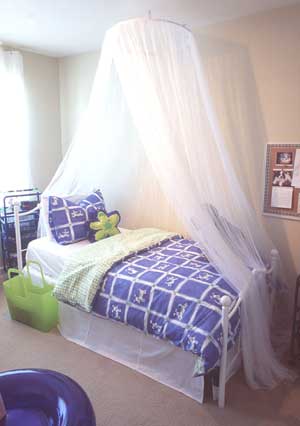
Jodi
Murphy of Redwood City made her daughter Molly feel like a queen by
putting mosquito netting over her bed.
Photo:
Patrick Tehan
GO TO YOUR ROOM! isn’t such a severe punishment now that kids’
rooms are more fun and stylish than ever.
Most people have an idea of how they want to decorate a baby’s
nursery. But what happens when a child grows out of his crib and you
crave a break from Beatrix Potter valances? Once children start
school, their rooms need to be retrofitted for sleeping in a
grown-up bed, spreading out and playing, doing messy school
projects, studying, and entertaining friends. By that point, too,
they’ve become strong-willed little individuals with decorating
ideas of their own. And they’ve usually collected enough treasures
and trinkets to fill a small museum, making creative storage a
necessity.
While you may have a specific vision for your little one’s room,
interior designers say that it’s important that the room reflects
your child’s personality and interests and not your own inner Pooh.
 |
|
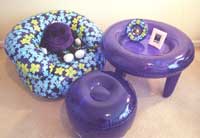
Although her mom designed her room, Molly, 11, chose
the inflatable furniture.
Photo:
Patrick Tehan |
‘‘Make sure the child shines in the room and the room doesn’t
overpower the child’s personality,’’ says interior designer Patricia
McDonald of McDonald & Moore Ltd. in San Jose. She adds that
it’s important to design a room that’s transitional enough for a
child to grow into, so you don’t have to redecorate yearly.
Here are a few more pointers from local designers on how to make
a child’s room fun, stylish and utilitarian, while also
incorporating your little designer’s decorating demands.
Include these must-haves: As a
child enters school he’ll need a comfortable desk and chair, space
for a computer, bookshelves, a bedside table and lamp, storage, a
bulletin board and a comfy spot to curl up and read, such as a
beanbag or small arm chair. It’s especially important to provide
adequate lighting throughout the room, says McDonald, including
direct lighting at the desk and by the bed and overhead lighting to
brighten the room for play.
Involve your kids in the design
process: ‘‘It’s funny how children develop style
standards at a very young age,’’ says McDonald. ‘‘We work directly
with children, finding out what they like to do and collect and what
colors they prefer. You want their interests to be a focal point,
whether it’s horses, artwork or sports.’’
While it’s their room, you probably don’t want to commit to
wall-to-wall Britney Spears. ‘‘Offer a selection of choices that you
can live with,’’ suggests Lynn Hollyn of Lynn Hollyn Associates in
Palo Alto, who did her animal-loving son’s room in a safari theme.
 |
|
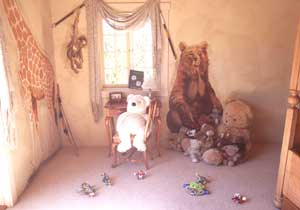
Lynn Hollyn of Palo Alto decorated her son’s bedroom
with murals of wild, but not ferocious-looking, animals.
Photo: Patrick Tehan
|
‘‘As they start getting older, kids begin asserting themselves in
the world and their rooms become a reflection of them,’’ explains
Jodi Murphy, chapter administrator of the American Society of
Interior Designers (ASID) and mother of an 11-year-old daughter and
13-year-old son. By age 11, Murphy’s daughter decided her room was
too babyish and called for a ban on anything pink. So Murphy, who
lives in Redwood City, did a fairly easy $500 overhaul, choosing a
simple shade of cream for the walls and Martha Stewart canvas shower
curtains with metal eye-hooks ($30) for a fun and functional window
treatment. While the bed has plain white sheets and dust ruffle, a
lime green and bright blue comforter cover and sham provided a punch
of color. Then Murphy created a clever canopy out of mosquito
netting from Pier 1 ($60), adding a dramatic touch that she says
makes her daughter feel like a queen.
Start with a theme or
color: From hot-air balloons
to horses, every child has a favorite theme, says Hollyn. So long as
it isn’t too trendy or outrageous, this is a good starting point for
decorating a room.
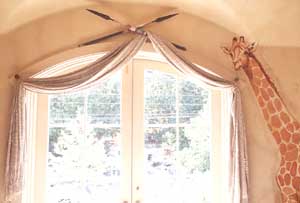
Hollyn’s son’s safari room features spears for curtain rods,
earthy raw silk for curtains and walls that simulate the inside of a
tent. The bedding is made of fuzzy fake leopard fur and squishy
beanbag chairs are covered in chenille leopard print. Then there’s a
melange of stuffed monkeys, giraffes and bears. But Hollyn warns
against a theme that’s over-stimulating or frightening for a child,
especially when the room is darkened at night. She made sure all the
animals in her son’s room look friendly and not ferocious.
Every child also has a favorite color, adds McDonald, who once
worked with a little girl who adored emerald green and fuchsia,
colors that were incorporated into a tropical wall covering of
bright banana leaves for her room. ‘‘Color enhances the spirit,’’
she explains. ‘‘You don’t want colors that will make the room too
busy or keep your child up all night, but you want a color that they
enjoy.’’
 |
|
An African safari motif is carried out in the curtain
rods in Lynn Hollyn's son's room.
Photo:
Patrick Tehan |
Find creative solutions for wall
hangings: From the Backstreet Boys to Michael Jordan,
kids love to plaster their walls with posters and pictures. But you
don’t want to wreck the walls with something they’ll grow tired of
in a matter of months.
McDonald came up with an especially creative solution for one
child’s room. Instead of curtains, she used shutters over the
windows, creating special panels for hanging posters on the room
side of the shutters with plywood backings and plexiglass covers
that can be unscrewed, allowing new posters to be inserted.
Julie Lanterman, of Interior Designs by Julie in Hillsborough,
suggests hanging corkboard that has been stained with wood stain to
match the room. It can be glued or screwed to the wall, allowing
kids to hang posters and pictures with thumbtacks.
Murphy created a ‘‘graffiti board’’ out of a huge blank canvas
($40) from Aaron Brothers for her daughter’s wall, picking out paint
pens in the same colors as the room. Her daughter and her friends
love the fact that they’re free to draw on the wall.
Provide plenty of storage: The best way to win the clean room battle is
to devise an organized storage system.
When Hollyn’s children were very young she put colored cubbies in
their rooms for storing blocks, books and toys, and cleaning up
became a game of putting the right items into the right cubbies.
‘‘The key is to help them organize clutter,’’ says Murphy. ‘‘Use
creative, cost-effective solutions and let them have as much input
as possible in developing the system and they’ll be more likely to
keep their rooms clean. A mother can only hope!’’ Murphy’s daughter
stores her wide assortment of belongings in plastic baskets on
rollers, which look neat and are easy to move around the room. Other
items are stashed in canvas boxes from Hold Everything.
 |
|
A painted monkey seems to swing from a curtain rod.
Photo: Patrick Tehan
|
For art supplies such as paper, brushes and crayons, McDonald
recommends shallow drawers about three inches deep, so young artists
don’t have to dig through heaps of stuff.
Limit trendy decor to
accessories: Kids’ tastes come and go as quickly as pop
stars, notes Murphy. By 9 they’re ready to ditch themes such as
Jedi, Pokémon and princess rooms. She says it’s best to limit trendy
themes to less expensive, easily replaceable accessories, such as
the bright plastic blow-up furniture that her daughter chose for her
room.
Other inexpensive accessories that make great accents and often
have fun, trendy themes include light switch plates, drawer knobs,
easy-to-replace wall borders and decals, small area rugs,
inexpensive sheet sets and decorated waste baskets.
Remember safety and durability:
‘‘Sometimes parents forget about safety,’’ notes McDonald. ‘‘But
nothing works design-wise if it’s not safe.’’ Key safety factors
include smoke alarms, rugs that don’t slip, cords that are tucked
safely away, windows fitted with locks, water-based paints and
bookshelves attached to the walls so they can’t tip over. Also make
sure chairs don’t tip back too easily and wall hangings are hung
securely and away from beds, in case of an earthquake.
Don’t go too high end: You
don’t want a room that’s so fancy your child can’t play in it.
McDonald advises against light carpet, suggesting a patterned,
tweedy or multi-colored look that will be better at hiding spills.
Hollyn says you should create a spill space for kids and always
have a drop cloth in their room. ‘‘Kids need space to make a mess so
they can do their artwork and school projects,’’ she explains,
adding that you can also create their spill space in the garage or
on a laundry room counter.
In the end, says Hollyn, ‘‘a child’s room should look wonderful,
but it should also have a curl-up appeal.’’ She explains that this
means you have to remember the tactile aspects of design. ‘‘I like
to think of a room in terms of how it will feel if you’re barefoot
in it. That’s why I like soft carpet and throws everywhere. The room
should sort of give you a hug.’’